How it works

A board a foreman can read without being taught.

Built on the paint that is already on the ground, and honest about the states that do not fit a day count.

The board

Built on the paint that's already on the ground.

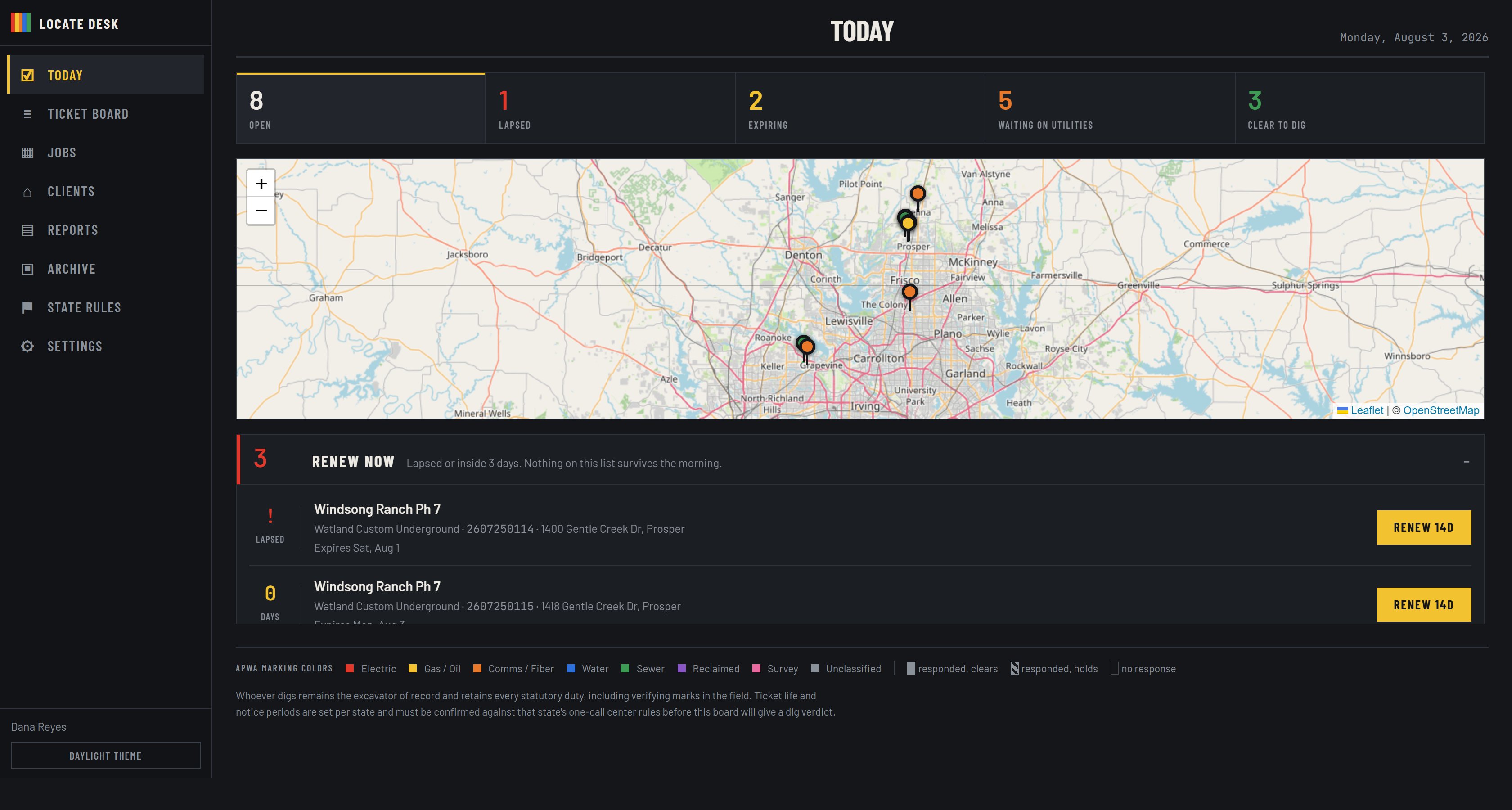
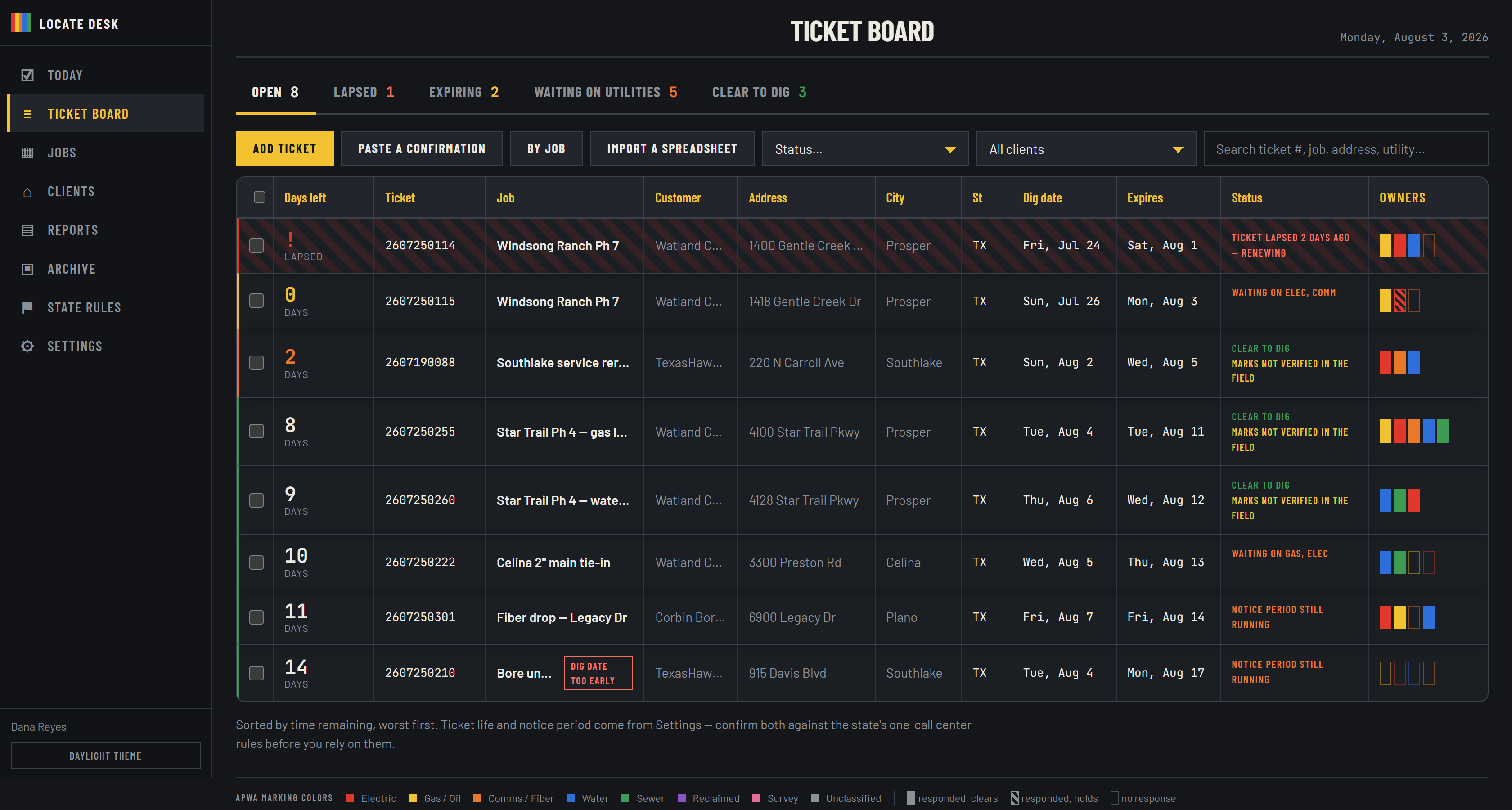
The interface uses the APWA uniform color code, so a foreman reads it without being taught. Every facility owner on a ticket is a bar in its marking color.

Solid

Responded, and it clears the dig.

Hatched

Responded, but it still holds the job.

Hollow

Nothing posted yet. That's the call list.

Hazard striping

The ticket has lapsed. Nobody needs a legend.

Electric Gas / Oil Comms / Fiber Water Sewer Reclaimed Survey

Beyond a spreadsheet

Four things a tracking sheet will never tell you.

01 Lawful start date, per state

Advance notice counted from the moment the ticket was first called in. Business days, calendar days, or clock hours, because states differ on all three. A planned dig date inside that window gets flagged in red on the board before anyone hooks up a trailer. Ask a competitor to show you that in a demo.

02 Clear to dig is a conclusion, not a checkbox

It isn't a field anybody can set. It's drawn from three independent gates: the ticket hasn't lapsed, the notice period has run out, and every notified facility owner has posted a response that clears. Nobody can accidentally mark a lapsed ticket clear.

03 Renewal arithmetic

Renewing restarts the expiration clock but not the notice period, and it resets every response to pending. Refreshed marks have to be re-confirmed rather than riding on a stale “marked” from three weeks ago.

04 Response aging

Who's been silent, for how long, worst first. That list is my morning, and it's the part that no software does for you. Somebody has to pick up the phone.

Fifty states, none of them guessed

The part nobody else will put in writing.

Every state sets its own notice period and ticket life. Some count business days, some count clock hours. Ticket life runs anywhere from under two weeks to a month.

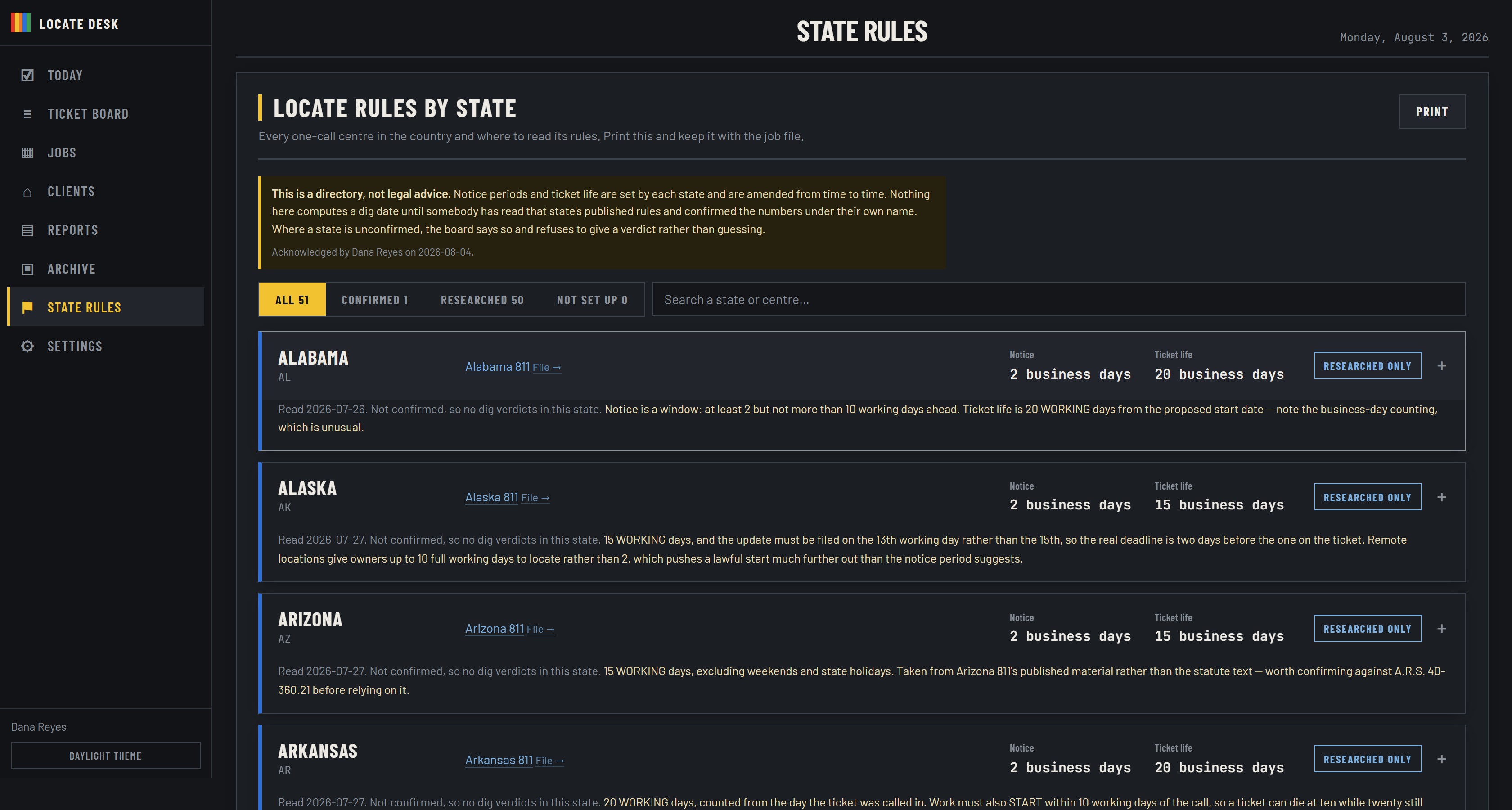
The system ships the whole directory. All 50 states plus DC, their one-call centers, and links to each center's published rules. For the states already worked through it also ships the research: the statute, the page it came from, and the date it was read. What it will not do is act on any of it.

A state stays unusable until an operator confirms its numbers and signs off, and that sign-off records who, when, and the URL they read. Until then the board returns rules not confirmed instead of a verdict, because a default notice period is a guess with a backhoe attached to it. Editing any number revokes the confirmation.

Some states don't fit a day count at all. Ohio and Pennsylvania never expire a ticket: the marks stand until they stop being legible. Printing a number for those would invent a legal deadline that does not exist, so the board prints none, and anything you enter is labelled as your own re-check cadence rather than an expiry.

I'm not going to tell you software keeps you legal. I'm telling you this one refuses to guess, and it writes down who decided what.

STATE RULES
N. Carolina 3 business days · 15 business day life Confirmed
Confirmed by C. Hegge · nc811.org · 2 Jun 2026
Ohio 48 hours · no fixed life Confirmed
Marks stand while they remain visible. No day count is shown, because Ohio does not set one.
Colorado not set · not set Not confirmed
Board returns no dig verdict for this state.
Straight about it

What this is not.

Overselling this is how you lose a contractor in month two. So, plainly:

No live hookup into an 811 center

There isn't one to have. No center publishes a lookup keyed to a ticket number, and the portals that will show you a ticket want a login. What every center does do is email you the confirmation, and that email holds the whole thing. One forwarding rule and your tickets land on the board by themselves. Anything read incompletely is held for review rather than filed, because a ticket that looks complete while a utility goes unchased is worse than one that plainly needs a look.

Nobody is asked to work a website at 5:40 a.m.

Your foremen can have logins, scoped so they record responses, renew and add notes but can never delete a ticket. The morning status still goes out as a text, because that's the channel that actually gets read from the cab of a truck.

No photo storage

The packet documents the ticket record and the call log, not field photos. Keep those with the job file.

The locate rules are confirmed, not warranted

Ticket life, notice period and the holiday calendar are set per state and confirmed against each one-call center. This is not legal advice, and you remain the excavator of record.

Want to see it against your own tickets?